Reports from India are pointing to an intense Indian monsoon this year [Indian monsoon death toll soars], saying "the rain on Tuesday was the heaviest recorded in a single day in India... More than 65cm (26 inches) fell in Mumbai."
I just wanted to post this article as yet another reminder that global climate change doesn't just affect the temperature. As global warming progresses, it is extremely likely that regional monsoons will be affected (in different ways in different regions). Similarly, some studies suggest the intensity of monsoons, droughts, tropical and midlatitude cyclones will all be larger in a warmer climate, or at least that variability will increase.
This matters for more than forecasting weather. People's lives are at stake, especially for the millions of people (most of them poor, despite places like Malibu) who live in low-lying coastal areas that are impacted by seasonal inclement weather. In places like Mumbai (and Malibu, I suppose), severe weather events can cost millions of dollars in damages, affecting local and non-local economies. Climate change has far-reaching consequences, as you knew already.
2005-07-28

Hush-hush Pacific climate agreement
Briefly looking at the news today, you will almost certainly have missed the announcement that the USA, China, India, Australia, South Korea, and Japan have made an agreement to reduce greenhouse gas emissions by the end of the century. That is, unless you are scouring the Australian news sites, like the Sydney Morning Herald, which ran the headline: Pact halves emissions by the next century. The agreement is tentatively called the "Asia Pacific Partnership on Clean Development and Climate."
I can't say that I actually know anything about this agreement. One reason for that is that it is not being covered anywhere, especially in the major USA news sources. This was also pointed out by Triple Pundit today. VOA did carry a story about it, by Scott Bobb [LINK], but it says no more than the SMH story.
Update/Correction: The big USA news agencies do in fact have the story. For example, I found the Reuters report buried in the NYTimes International section. I still don't see the story at all in the LATimes though.
Okay, so we see that the story isn't being covered very well. Why is that? Well there are two possibilities. First, it might be because no one cares about covering important climate-economic policy news, but that is unlikely. Second, it could be because it is a non-story. I'm ignoring the possibility that there is a vast conspiracy to hide the Bush administration's concern over climate change. I think the second possibility is most likely. According to the stories I have found about this agreement, it is focused on techonology and sharing technology.
The idea is that by using more efficient technologies, greenhouse gas emissions can be cut significantly. We've started to hear this from the GWB administration recently, despite Dick Cheney's well-known distaste for conservation. The agreement doesn't seem to set limits or goals for cutting emissions, which means there's nothing to enforce. Apparently there will be a fund into which each member state will deposit money for R&D of new efficient technologies.
Using more efficient technologies is a great idea! I think we should do it right now. Maybe we could pass a bill that says that all new power plants must meet specified minimum standards. We could even build in a grandfather clause so that old power plants could keep working, and just install new, efficient equipment when they need to replace old equipment. Let's call it the Clean Air Act. Oh, wait, didn't we do that in 1970? IT DID NOT WORK. There are loopholes, and as long as the government allows dirty energy to be cheaper than clean energy (through massive subsidies on oil and coal, and poor enforcemnent of the Clean Air Act and others), there is no way that better technologies will be able to compete. Add to that the new "energy bill" that may be making its way through congress right now [LINK], and we see that this new Pacific agreement is, for the USA at least, nothing but lip service and business as usual.
When will the USA government wake up to the realities of climate change? When will it understand that energy security is not about military action in the Middle East? When will the largest economy, most lawful democracy, and most technologically advanced country in the world take its responsibility to be a world leader in the arena of climate change and alternative energy seriously? As far as I can see, the answer to this last question is only, when it isn't the USA.
I can't say that I actually know anything about this agreement. One reason for that is that it is not being covered anywhere, especially in the major USA news sources. This was also pointed out by Triple Pundit today. VOA did carry a story about it, by Scott Bobb [LINK], but it says no more than the SMH story.
Update/Correction: The big USA news agencies do in fact have the story. For example, I found the Reuters report buried in the NYTimes International section. I still don't see the story at all in the LATimes though.
Okay, so we see that the story isn't being covered very well. Why is that? Well there are two possibilities. First, it might be because no one cares about covering important climate-economic policy news, but that is unlikely. Second, it could be because it is a non-story. I'm ignoring the possibility that there is a vast conspiracy to hide the Bush administration's concern over climate change. I think the second possibility is most likely. According to the stories I have found about this agreement, it is focused on techonology and sharing technology.
The idea is that by using more efficient technologies, greenhouse gas emissions can be cut significantly. We've started to hear this from the GWB administration recently, despite Dick Cheney's well-known distaste for conservation. The agreement doesn't seem to set limits or goals for cutting emissions, which means there's nothing to enforce. Apparently there will be a fund into which each member state will deposit money for R&D of new efficient technologies.
Using more efficient technologies is a great idea! I think we should do it right now. Maybe we could pass a bill that says that all new power plants must meet specified minimum standards. We could even build in a grandfather clause so that old power plants could keep working, and just install new, efficient equipment when they need to replace old equipment. Let's call it the Clean Air Act. Oh, wait, didn't we do that in 1970? IT DID NOT WORK. There are loopholes, and as long as the government allows dirty energy to be cheaper than clean energy (through massive subsidies on oil and coal, and poor enforcemnent of the Clean Air Act and others), there is no way that better technologies will be able to compete. Add to that the new "energy bill" that may be making its way through congress right now [LINK], and we see that this new Pacific agreement is, for the USA at least, nothing but lip service and business as usual.
When will the USA government wake up to the realities of climate change? When will it understand that energy security is not about military action in the Middle East? When will the largest economy, most lawful democracy, and most technologically advanced country in the world take its responsibility to be a world leader in the arena of climate change and alternative energy seriously? As far as I can see, the answer to this last question is only, when it isn't the USA.
2005-07-27
a small story
I saw this link on the front page of the BBC news website today:
BBC NEWS | Africa | Polygamy no fun, admits Ethiopian
I'm not going to say anything about it, you can come to your own conclusions.
BBC NEWS | Africa | Polygamy no fun, admits Ethiopian
I'm not going to say anything about it, you can come to your own conclusions.
2005-07-19
Brazil, a land of contrasts
Another story out of Wired, this one dated 16 May 2005, reports on the success Brazil is having with ethanol and biodiesel [LINK]. Usually people say that using biofuel is a zero sum gain as far as climate change goes, since it takes carbon from the living biosphere and puts it into the atmosphere, only to be reabsorbed by the biosphere as new crops are grown. So, if this holds, as it should I guess, Brazil is starting to get it. Unfortunately, Brazil is also destroying the Amazon at an alarming rate [LINK].
Baby steps forward in Africa (Rwanda)
In a story sent to me today by Mel S., Cyrus Farivar writes for Wired about Rwandan prisons recycling the human waste to generate first energy for cooking and lighting and second fertilizer for the prison gardens [LINK]. Basically they collect the wast and ferment it, collecting the methane produced and burning it as fuel. It's a good idea, and has won an Ashden Award. I have a sneaking suspiscion that they could streamline the process for efficiency, though, and produce much more energy and probably lose much less of the very, very greenhouse gas, methane. Definitely a good idea though, and a great story out of the heart of Africa.
2005-07-18
Just some links to keep you happy
Hell-O blog-readers!
After coming into the office this morning after a relaxing, news-free weekend, I started reading news and getting agitated. Not all of it is climate related (which, is supposedly this blog's theme, supposedly), but I thought I'd just throw out some of the articles I've read this morning.
So the big news in the atmosphere is Hurricane Emily, which has now crossed the Yucatan. I wonder how close the eye came to the impact site of the meteor that ended the dinosaurs' reign? I suppose that the diameter of the hurricane is bigger than the crater, but amazingly has less energy than that unleashed by the impact. That's a lot of energy. For up to the date information, see the National Hurricane Center.
Slightly concerning for those of us with ties to environmental groups, the FBI has been keeping tabs on some groups that support environmental (or social or progressive) activism [LINK]. Why? More importantly than 'why?' is the more specific question, why are they doing so with anti-terrorism task forces and funds? This is blantantly politically motivated. This sort of behavior by the federal government is taking us back in time to more invasive and paranoid days, and simultaneously toward a very Orwellian future.
Getting less related, but still sort of following the lines of this blog, the solar car race is happening. There's a story in the SF Chronicle about it [LINK], with a focus on the Cal and Stanford teams. While racing this fragile little solar cars seems silly and just a diversion, the technologies and skills and press coverage that this race and these teams generate will help move away from the dirty hydrocarbon economy that we live in today. More information about the American Solar Challenge can be found at americansolarchallenge.org.
Moving away from environmental and climate issues completely, but staying in the realm of science, there's a news story about a new study of an extra solar planet that orbits three suns. None of the stories I read really do this story justice, but it sounds really interesting, and might have important ramifications for understanding how solar systems form [LINK].
And moving past hard science news, and into more murky waters, there's a column by Gina Piccalo in the LATimes about atheists in America. It's kind of a strange piece in the sense that it implies that there's a lot of stigma attached to being an atheist in today's USA [LINK]. No doubt there is in some places. No doubt that religious types feel various feelings ranging from confusion to pity to anger and hate and fear when confronted with real-life atheists. However, this probably isn't a serious issue for most atheists, at least in my experience. I'd guess that at least half the people I know are atheist or at least agnostic, and I don't think they are facing much difficulty due to non-belief. Well, I hope not. The column also mentions, and reminded me of, a great web site for those out there who don't invoke mystical forces in their world-view. It is called the Brights' Net, and I have to say that I think it is a clever and harmless site/idea. It is very non-confrontational, very pro-people, and doesn't condemn anyone.
So that's what's been on my mind today. Also, crude oil prices dropped this morning to about $57.20/barrel. However, as I understand it, today the whole market is adjusting to some kind of profit reports or something... so everything seems to have gone down a bit.
After coming into the office this morning after a relaxing, news-free weekend, I started reading news and getting agitated. Not all of it is climate related (which, is supposedly this blog's theme, supposedly), but I thought I'd just throw out some of the articles I've read this morning.
So the big news in the atmosphere is Hurricane Emily, which has now crossed the Yucatan. I wonder how close the eye came to the impact site of the meteor that ended the dinosaurs' reign? I suppose that the diameter of the hurricane is bigger than the crater, but amazingly has less energy than that unleashed by the impact. That's a lot of energy. For up to the date information, see the National Hurricane Center.
Slightly concerning for those of us with ties to environmental groups, the FBI has been keeping tabs on some groups that support environmental (or social or progressive) activism [LINK]. Why? More importantly than 'why?' is the more specific question, why are they doing so with anti-terrorism task forces and funds? This is blantantly politically motivated. This sort of behavior by the federal government is taking us back in time to more invasive and paranoid days, and simultaneously toward a very Orwellian future.
Getting less related, but still sort of following the lines of this blog, the solar car race is happening. There's a story in the SF Chronicle about it [LINK], with a focus on the Cal and Stanford teams. While racing this fragile little solar cars seems silly and just a diversion, the technologies and skills and press coverage that this race and these teams generate will help move away from the dirty hydrocarbon economy that we live in today. More information about the American Solar Challenge can be found at americansolarchallenge.org.
Moving away from environmental and climate issues completely, but staying in the realm of science, there's a news story about a new study of an extra solar planet that orbits three suns. None of the stories I read really do this story justice, but it sounds really interesting, and might have important ramifications for understanding how solar systems form [LINK].
And moving past hard science news, and into more murky waters, there's a column by Gina Piccalo in the LATimes about atheists in America. It's kind of a strange piece in the sense that it implies that there's a lot of stigma attached to being an atheist in today's USA [LINK]. No doubt there is in some places. No doubt that religious types feel various feelings ranging from confusion to pity to anger and hate and fear when confronted with real-life atheists. However, this probably isn't a serious issue for most atheists, at least in my experience. I'd guess that at least half the people I know are atheist or at least agnostic, and I don't think they are facing much difficulty due to non-belief. Well, I hope not. The column also mentions, and reminded me of, a great web site for those out there who don't invoke mystical forces in their world-view. It is called the Brights' Net, and I have to say that I think it is a clever and harmless site/idea. It is very non-confrontational, very pro-people, and doesn't condemn anyone.
So that's what's been on my mind today. Also, crude oil prices dropped this morning to about $57.20/barrel. However, as I understand it, today the whole market is adjusting to some kind of profit reports or something... so everything seems to have gone down a bit.
2005-07-16
Oil... *sigh*
As I haven't really posted much lately, here's a little something from The End of Oil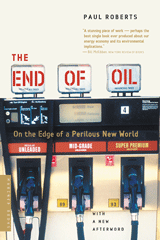 , which I'm just about done reading finally.
While we can quibble over some of the numbers (and remember that this book is now about 2 years old, so things have gotten even worse), this is another in a big pile of examples out there about how we need to straighten up in terms of our energy consumption. Oil is going fast, and climate is changing faster. This is not a problem for the next generation or the one after that. These are issues that will be the MOST IMPORTANT IN THE WORLD in the next decade. This IS LIFE AND DEATH for thousands - maybe millions - of people who are alive today. Let's address things now and save the world... does that sound optimistic? Yeah, you didn't think I could do it, did you?
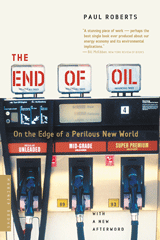 , which I'm just about done reading finally.
American cars and trucks burn two of verery three barrels of oil used in the United states -- and one of every seven worldwide -- a figure that is hardly surprising, given that economy standards have been frozen since 1988. Today, American cars need to achieve and average fuel economy of just 27.5 miles per gallon, while "light trucks," that hugely popular category that includes pickups and SUVs, need achieve only 20.5 miles per gallon. Even a modest improvement in fuel-economy standards -- say, 32 mpg for cars and 24 mpg for light trucks -- would by 2010 be saving 2.7 million barrels per day -- or nearly twice as much as could be pumped every day from the Arctic National Wildlife Refuge.
While we can quibble over some of the numbers (and remember that this book is now about 2 years old, so things have gotten even worse), this is another in a big pile of examples out there about how we need to straighten up in terms of our energy consumption. Oil is going fast, and climate is changing faster. This is not a problem for the next generation or the one after that. These are issues that will be the MOST IMPORTANT IN THE WORLD in the next decade. This IS LIFE AND DEATH for thousands - maybe millions - of people who are alive today. Let's address things now and save the world... does that sound optimistic? Yeah, you didn't think I could do it, did you?
2005-07-11
Are you callin' me out?
So, as my iMac continues to compile, I keep reading Nature articles to amuse myself. The editorial this week is about one Representative Joe Barton (R, TX), who has sent official-ish inquiries to several climate scientists asking for more information about their research [LINK]. Yes, that seems good, except we know that this is politically motivated, and Barton is looking for holes to exploit. He's not a very good environmentalist. Barton is using an article from the Wall Street Journal as his guide to understanding the science involved. Unfortunately, the WSJ is a right-wing rag, at least in its editorials. RealClimate.org has addressed a recent, related WSJ editorial (21 June 2005), refuting it's conclusions beyond a reasonable doubt [LINK]. The Nature editorial doesn't say too much, except that these are issues that are being exploited and politicized, and that they are too important to do that. The editors of Nature are correct.
Let's party like it's 2005!
Okay, one more while my iMac is compiling things...
This year we have an extra second to savour (yeah, it looks British, doesn't it) the sweet year that has been 2005. Yes, a leap second has been announced, to be added to the final moments of the year [LINK]. The extra second is added to make up for small variations in the length of day (i.e., Earth's rotation).
How will you spend your bonus time?
This year we have an extra second to savour (yeah, it looks British, doesn't it) the sweet year that has been 2005. Yes, a leap second has been announced, to be added to the final moments of the year [LINK]. The extra second is added to make up for small variations in the length of day (i.e., Earth's rotation).
How will you spend your bonus time?
Crikey! ... oh, wait, Aussies don't really say that...
So this is just too cool not to post, despite it being off topic. Researchers from Australia have applied acoustic physics to understand how didgeridoos make those crazy sounds [LINK]. Apparently it's all about changing the position of the glottis (part of the windpipe), enhancing certain frequencies and getting a different resonance inside the didgeridoo. So neat!
2005-07-02
The emperor has no clothes, Bush announces.
Will he actually do it? Will GWB actually say he believes in climate change? An article in the TimesOnline [LINK] suggests he might this week at the G8 conference. Of course, if we're to believe all the rumors and conjectures about the conference, all foreign debt will be forgiven, new energy sources will be developed, tested, and implemented, food sources will be secured, and all disease will be erradicated. But maybe, just maybe, GWB will finally say something like, "climate change is real, and it is a problem that we need to deal with. Let's smoke'em out!" Or something like that.
2005-06-27
Amber Waves of Plastic
Wouldn't it be nice to have bio-degradable plastic? Well, it turns out that not only does it exist, but it's apparently gaining some popularity. An article in the LATimes by Stephanie Simon [LINK] covers the basic ideas. Here's one promising quote:
The article also mentions several companies that have products made from bio-plastic. Some of them are big corporations, but some are smaller, and I thought I might add a couple links just to get the word out. So here they are:
Okay, so that was all for now. Bio-plastic. Space age!! How about growing some bacteria or algae that can just keep reproducing and be harvested for bio-plastic... there's a multi-billion dollar idea.
"'Anything you can make out of petroleum, I can make out of corn and soybeans,' said Larry Johnson, director of the Center for Crops Utilization Research at Iowa State University.
The article also mentions several companies that have products made from bio-plastic. Some of them are big corporations, but some are smaller, and I thought I might add a couple links just to get the word out. So here they are:
- Of the Earth (Oregon, Apparel) [LINK]
- Pacific Coast Feather Company (Washington, Beds, Pillows, linens, etc... but I don't know about their animal friendliness yet) [LINK]
- Faribauli Mills (Minnesota, Blankets)[LINK]
Okay, so that was all for now. Bio-plastic. Space age!! How about growing some bacteria or algae that can just keep reproducing and be harvested for bio-plastic... there's a multi-billion dollar idea.
2005-06-22
But Chinese is such a difficult language!
The LA Times has a story today by Evelyn Iritani about the Chinese interest in US businesses [LINK]. I am particularly interested in how this apparent bid by CNOOC Ltd. for Unocal is going to play out. Probably Chevron has them beat, but keep yours eyes peeled. Either way, we are seeing consolidation in the oil industry already, as oil prices climb ever higher. By the way, don't believe this BS about not having enough refineries; that is not why crude oil prices are rising.
See, it's not only NASA
Melinda Mahaffey reports on the Outside Online website [LINK] that the Planetary Society's experimental solar sailing spacecraft was launched, and is now missing. Sad news, to be sure. Solar sails are kind of interesting, and might not be a bad idea, if combined with some kind of engine to get accelerated at the start. The PS still hopes the Cosmos 1 is alive and well, but it seems pretty unlikey at this point.
2005-06-15
Deep throat of climate change
So a guy named Piltz has singled out Philip Cooney and Harlan Watson as key players in the administration misusing and misrepresenting climate science [LINK]. I can't go into any depth on this issue here and now, but this is the kind of story that should be out there making big news. Cooney has resigned over the allegations, which I think means something. I'll certainly be trying to follow up on this in coming days. Any input or insight from you would be great... send links if you got 'em.
2005-06-01
Hurricanes and climate change
I have commented before about how it is hard to write about findings and controversies in fields closely related to one's own. Today I'm going to go a step further by complaining (or commenting, or reporting, or opining) about a subject that is basically my own field of study, but about which I know very little. Today's topic, without further adieu, is the link between hurricanes and climate change.
My interest in this, at least my more intense interest right now (which will probably dissipate in about 10 minutes), was spawned by an article on the Environmental News Network [LINK], apparently originating from Reuters and written by Michael Chirstie. Here's a quote:

The Landsea referred to is Chris Landsea, a well-known atmospheric scientist. Kerry Emanuel is an expert on hurricane intensity and atmospheric convection.
Reading this story made me wonder about the possibility of hurricanes being affected by a warming climate. This is not something I haven't thought of in the past, but I never thought of it as particularly provocative or controversial.
There are a couple of issues here. Well, more than a couple, but only a couple that I want to touch on here. First, we need to address how this story is being covered by this article. After that, I want to just think about the science briefly, mostly to raise some points that are not related to what is being discussed in the article but are obviously relevant to the spirit of the article.
The first point is pretty straightforward. The article is focusing on the potential damage, in terms of dollars, of tropical storms, specifically hurricanes. A hurricane is just a tropical cyclone with a high degree of organization, allowing stronger winds and the famous "eye." The article is really trying to discuss a correlation between hurricane intensity and global warming. It mentions that there is believed to be a long term cycle associated with tropical cyclone intensity, and also notes that "climatologists" believe there is also a trend in "hurricane activity." It highlights this debate, but also tries to bring politics into it by mentioning that some climate scientists feel they are being forced to downplay climate change evidence. In short, the article is confused on several levels.
First let's actually ignore politics other than scientific ones. That is, it is safe to assume that whatever debate is at hand has nothing to do with the federal government or funding or anything like that. These are good scientists who are doing good work, and may or may not have differing opinions based on the evidence.
Next, let's decide what "hurricane activity" is. In my opinion, "hurricane activity" is really referring to the number of hurricanes, or more generally the number of tropical cyclones generated. This is a research area known as cyclogenesis, which maybe could be specialized by tropical cyclogenesis. However, the article itself goes on to discuss the strength, or intensity, of hurricanes. Kerry Emanuel, the same one as above, has a simple thermodynamic model that predicts the potential strength of tropical cyclones. It doesn't deal with cyclogenesis though. The model assumes a cyclone exists, and then just guesses how strong it could give based on the conditions in which it exists. In the article, everyone seems to conclude that in a warmer climate, there would be a slight increase in hurricane strength. This is not something that can be put in stone yet, but let's just take it as given: in a warmer climate conditions will allow hurricanes to be slightly (around 10%) stronger, in terms of maximum sustained wind speed. Fine. However, earlier in the article says, "Last season's $45 billion devastation, when 15 tropical storms spawned nine hurricanes in the Atlantic and Caribbean, prompted climatologists to warn of a link to warming temperatures." This doesn't say anything about hurricane intensity, but rather hurricane frequency.

Now let's think about each effect separately. Does global warming suggest changes in (A) hurricane intensity and/or (B) hurricane frequency.
For (A), we already agreed. Yes. There is probably going to be a slight increase in hurricane intensity, but it probably won't be incredibly dramatic. Warmer sea-surface temperature, greater wind shear, and higher low-level relative humidity will all contribute to stronger tropical cyclones.
What about (B) though? This is the hard part, since the subject of cyclogenesis is tricky. What "spins up" hurricanes? You need to have a big blob of organized convection in the tropics, which then propagates poleward and begins to spin and become more organized. That initial blob and the subsequent propagation and organization are hard to predict. They depend on a delicate balance of wind and moisture influences all happening over nice warm water. A lot of people who think real hard about this have been saying, for many years now, that a key ingredient for many tropical cyclones is a passing "easterly wave." That is, an organized motion in the atmosphere coming from the east. The idea is that the easterly wave can help the initial organization of the storm, and then moves away and allows the cyclone to move away and strengthen. (At least, that's the way I've interpreted it so far.) In the Atlantic, and maybe even in the eastern Pacific, these waves originate over northern Africa. Understanding of these waves, and the precise way they help organize convection over the ocean. is still just beginning. There's a lot of work to be done. What can we say then about cyclogenesis under a global warming scenario? Well, we can expect that these easterly waves have something to do with heating over the continent, which is likely to increase in a warmer climate. Whether this increases the number of waves or the amplitude is not yet known. How such changes would change the number of tropical storms formed is also unknown. The first guess would be that there would be more easterly waves of significant enough amplitude that more cyclones can form and propagate poleward.
If that guess is true, which can't yet be confirmed, at least by me, we can guess the future. More hurricanes in the future, with a slightly higher average intensity. This is not what Chris Landsea thinks will happen, which you can read about on NOAA's Atlantic Oceanographic and Meteorological Laboratory website [LINK]. He cites a few studies, and comes to approximately the same conclusion about peak intensity, but refrains from saying anything about average intensity. However, he doesn't seem to see any reason to believe more or less hurricanes will form. The main reason is that the whole atmosphere will change, so the thresholds for cyclogenesis will change. This, I think, neglects the importance of easterly waves in cyclogenesis. As you can see, this is a complicated problem, and there's no reason to think there should be consensus at this point.
As a further caveat, it is also conceivable that more and/or more intense easterly waves originating over northern Africa could also reduce hurricane formation. By carrying very warm, dry air over the ocean, where young hurricanes might be forming, these layers, called "Saharan air layers," could inhibit convection and stop the hurricane in its tracks. So, yeah, basically you read all the way down to here to find out that we (or I at least) have no answers for you. Sorry about that.
My interest in this, at least my more intense interest right now (which will probably dissipate in about 10 minutes), was spawned by an article on the Environmental News Network [LINK], apparently originating from Reuters and written by Michael Chirstie. Here's a quote:
"...studies by Kerry Emanuel, a professor of meteorology at the Massachusetts Institute of Technology, indicate the 2 degree Celsius (3.6 degrees Fahrenheit) increase in sea surface temperatures predicted by the IPCC would raise the upper limit on a storm's intensity by 10 percent. Landsea said those changes were largely imperceptible given the overall ferocity of hurricanes. "
The Landsea referred to is Chris Landsea, a well-known atmospheric scientist. Kerry Emanuel is an expert on hurricane intensity and atmospheric convection.
Reading this story made me wonder about the possibility of hurricanes being affected by a warming climate. This is not something I haven't thought of in the past, but I never thought of it as particularly provocative or controversial.
There are a couple of issues here. Well, more than a couple, but only a couple that I want to touch on here. First, we need to address how this story is being covered by this article. After that, I want to just think about the science briefly, mostly to raise some points that are not related to what is being discussed in the article but are obviously relevant to the spirit of the article.
The first point is pretty straightforward. The article is focusing on the potential damage, in terms of dollars, of tropical storms, specifically hurricanes. A hurricane is just a tropical cyclone with a high degree of organization, allowing stronger winds and the famous "eye." The article is really trying to discuss a correlation between hurricane intensity and global warming. It mentions that there is believed to be a long term cycle associated with tropical cyclone intensity, and also notes that "climatologists" believe there is also a trend in "hurricane activity." It highlights this debate, but also tries to bring politics into it by mentioning that some climate scientists feel they are being forced to downplay climate change evidence. In short, the article is confused on several levels.
First let's actually ignore politics other than scientific ones. That is, it is safe to assume that whatever debate is at hand has nothing to do with the federal government or funding or anything like that. These are good scientists who are doing good work, and may or may not have differing opinions based on the evidence.
Next, let's decide what "hurricane activity" is. In my opinion, "hurricane activity" is really referring to the number of hurricanes, or more generally the number of tropical cyclones generated. This is a research area known as cyclogenesis, which maybe could be specialized by tropical cyclogenesis. However, the article itself goes on to discuss the strength, or intensity, of hurricanes. Kerry Emanuel, the same one as above, has a simple thermodynamic model that predicts the potential strength of tropical cyclones. It doesn't deal with cyclogenesis though. The model assumes a cyclone exists, and then just guesses how strong it could give based on the conditions in which it exists. In the article, everyone seems to conclude that in a warmer climate, there would be a slight increase in hurricane strength. This is not something that can be put in stone yet, but let's just take it as given: in a warmer climate conditions will allow hurricanes to be slightly (around 10%) stronger, in terms of maximum sustained wind speed. Fine. However, earlier in the article says, "Last season's $45 billion devastation, when 15 tropical storms spawned nine hurricanes in the Atlantic and Caribbean, prompted climatologists to warn of a link to warming temperatures." This doesn't say anything about hurricane intensity, but rather hurricane frequency.
Now let's think about each effect separately. Does global warming suggest changes in (A) hurricane intensity and/or (B) hurricane frequency.
For (A), we already agreed. Yes. There is probably going to be a slight increase in hurricane intensity, but it probably won't be incredibly dramatic. Warmer sea-surface temperature, greater wind shear, and higher low-level relative humidity will all contribute to stronger tropical cyclones.
What about (B) though? This is the hard part, since the subject of cyclogenesis is tricky. What "spins up" hurricanes? You need to have a big blob of organized convection in the tropics, which then propagates poleward and begins to spin and become more organized. That initial blob and the subsequent propagation and organization are hard to predict. They depend on a delicate balance of wind and moisture influences all happening over nice warm water. A lot of people who think real hard about this have been saying, for many years now, that a key ingredient for many tropical cyclones is a passing "easterly wave." That is, an organized motion in the atmosphere coming from the east. The idea is that the easterly wave can help the initial organization of the storm, and then moves away and allows the cyclone to move away and strengthen. (At least, that's the way I've interpreted it so far.) In the Atlantic, and maybe even in the eastern Pacific, these waves originate over northern Africa. Understanding of these waves, and the precise way they help organize convection over the ocean. is still just beginning. There's a lot of work to be done. What can we say then about cyclogenesis under a global warming scenario? Well, we can expect that these easterly waves have something to do with heating over the continent, which is likely to increase in a warmer climate. Whether this increases the number of waves or the amplitude is not yet known. How such changes would change the number of tropical storms formed is also unknown. The first guess would be that there would be more easterly waves of significant enough amplitude that more cyclones can form and propagate poleward.
If that guess is true, which can't yet be confirmed, at least by me, we can guess the future. More hurricanes in the future, with a slightly higher average intensity. This is not what Chris Landsea thinks will happen, which you can read about on NOAA's Atlantic Oceanographic and Meteorological Laboratory website [LINK]. He cites a few studies, and comes to approximately the same conclusion about peak intensity, but refrains from saying anything about average intensity. However, he doesn't seem to see any reason to believe more or less hurricanes will form. The main reason is that the whole atmosphere will change, so the thresholds for cyclogenesis will change. This, I think, neglects the importance of easterly waves in cyclogenesis. As you can see, this is a complicated problem, and there's no reason to think there should be consensus at this point.
As a further caveat, it is also conceivable that more and/or more intense easterly waves originating over northern Africa could also reduce hurricane formation. By carrying very warm, dry air over the ocean, where young hurricanes might be forming, these layers, called "Saharan air layers," could inhibit convection and stop the hurricane in its tracks. So, yeah, basically you read all the way down to here to find out that we (or I at least) have no answers for you. Sorry about that.
2005-05-20
Just the tip of the rapidly melting iceberg
A small story from NYTimes, by Danny Hakim, says that the trend in SUV purchases lost a little steam in the first quarter of 2005. Here's a particularly egregious statement by a Houston auto-purchaser:
This is what she said as she was buying a Chevrolet 300C. While some consumers are starting to think about fuel economy, I fear that a great many still see the current spate of high gas prices as only that. A temporary increase, probably associated with the summer season. But, Ms. Cook, you are wrong. Things are going to get worse and worse. This is our chance to take some steps away from petroleum, and we really should take them.
The New York Times > Automobiles > A Love Affair With S.U.V.'s Begins to Cool: "For Ms. Cooks, gas prices, which are $2.09 a gallon for regular at a Shell station nearby, were not part of her decision, and she said she came close to buying a Lexus S.U.V. The 300C, equipped with a gas guzzling Hemi engine, is hardly akin to a Toyota Prius.
'Gas prices worry me with any vehicle,' she said. 'One day they're up, the next day they're slightly down.'"
This is what she said as she was buying a Chevrolet 300C. While some consumers are starting to think about fuel economy, I fear that a great many still see the current spate of high gas prices as only that. A temporary increase, probably associated with the summer season. But, Ms. Cook, you are wrong. Things are going to get worse and worse. This is our chance to take some steps away from petroleum, and we really should take them.
2005-05-15
Well, what else can we do?
In a rather bland report, NYTimes reporter Felicity Barringer [LINK] says some long-time "environmentalists" are starting to accept the possibility that using nuclear power might be a viable option. While I accept that waste generation and storage/disposal are important problems that still haven't been adequately solved, I have long been in the pro-nuclear power camp. The public at large has serious issues with anything "nuclear" or "radioactive," but it seems like that might have something to do with growing up in a world in which they were constantly threatened with nuclear annihilation. Duck and cover, anyone?
Today we have to make decisions with imperfect knowledge and technology. On the one hand we know that fossil fuels are starting to run low (by the way, I still like "Out of Gas", see previous post) and we also know that using them is contributing to a warming planet. On the other hand, we are afraid of using nuclear technology because it can be used for unfriendly purposes and we don't have a very good way to take care of the waste. Also, nuclear fission is not really a renewable energy source, unless we can mine Uranium out of Earth's core. What do we do? Should we abandon both and hope that somehow other renewable energy sources are quickly improved? I'd say that is not the best solution. Let's face up to the facts, and say that the dangers posed by nuclear power right now are far smaller than those posed by fossil fuels or a global energy crisis. With that decision, the immediate future should rely heavily on nuclear fission, with at least one eye toward the future, which should include nuclear fusion along with renewable energy sources (solar, wind, etc.). Or at least that's how it seems to me.
Today we have to make decisions with imperfect knowledge and technology. On the one hand we know that fossil fuels are starting to run low (by the way, I still like "Out of Gas", see previous post) and we also know that using them is contributing to a warming planet. On the other hand, we are afraid of using nuclear technology because it can be used for unfriendly purposes and we don't have a very good way to take care of the waste. Also, nuclear fission is not really a renewable energy source, unless we can mine Uranium out of Earth's core. What do we do? Should we abandon both and hope that somehow other renewable energy sources are quickly improved? I'd say that is not the best solution. Let's face up to the facts, and say that the dangers posed by nuclear power right now are far smaller than those posed by fossil fuels or a global energy crisis. With that decision, the immediate future should rely heavily on nuclear fission, with at least one eye toward the future, which should include nuclear fusion along with renewable energy sources (solar, wind, etc.). Or at least that's how it seems to me.
2005-05-12
It doesn't relate to the things I usually post here, but this is too cool not to mention. Some folks at Cornell have made a robot that reproduces itself! Yes, all our dreams have come true. Okay, well, it isn't quite that good, since all it does is reproduce itself, and it can only do that in idealized conditions. It is still a very impressive demonstration. The future applications are endless, once the technology (hardware & sofware) advances. The story can be found on wired.com, and is written by Stephen Leahy [LINK].
2005-05-10
A helpful site?
So I heard about this "new" website called GreenerChoices.org. I haven't looked at it much yet, but it might be useful from what I see. It seems to be from Consumer Reports, which isn't a bad thing. If I find anything particularly good, I'll post it later.
Subscribe to:
Posts (Atom)